API 610 Centrifugal Pump Selection for Boiler Feed Service
A comprehensive comparative guide to selecting between Overhung (OH2), Axially Split Between-Bearings (BB3), and Double-Casing Barrel (BB5) centrifugal feed pumps based on operating pressure, thermal cycling severity, and API 682 seal flush plans.
Selection Matrix Summary
- OH2 (<20 bar): Single-stage overhung centerline-mounted. Best for packaged firetube boilers and small industrial hot water loops.
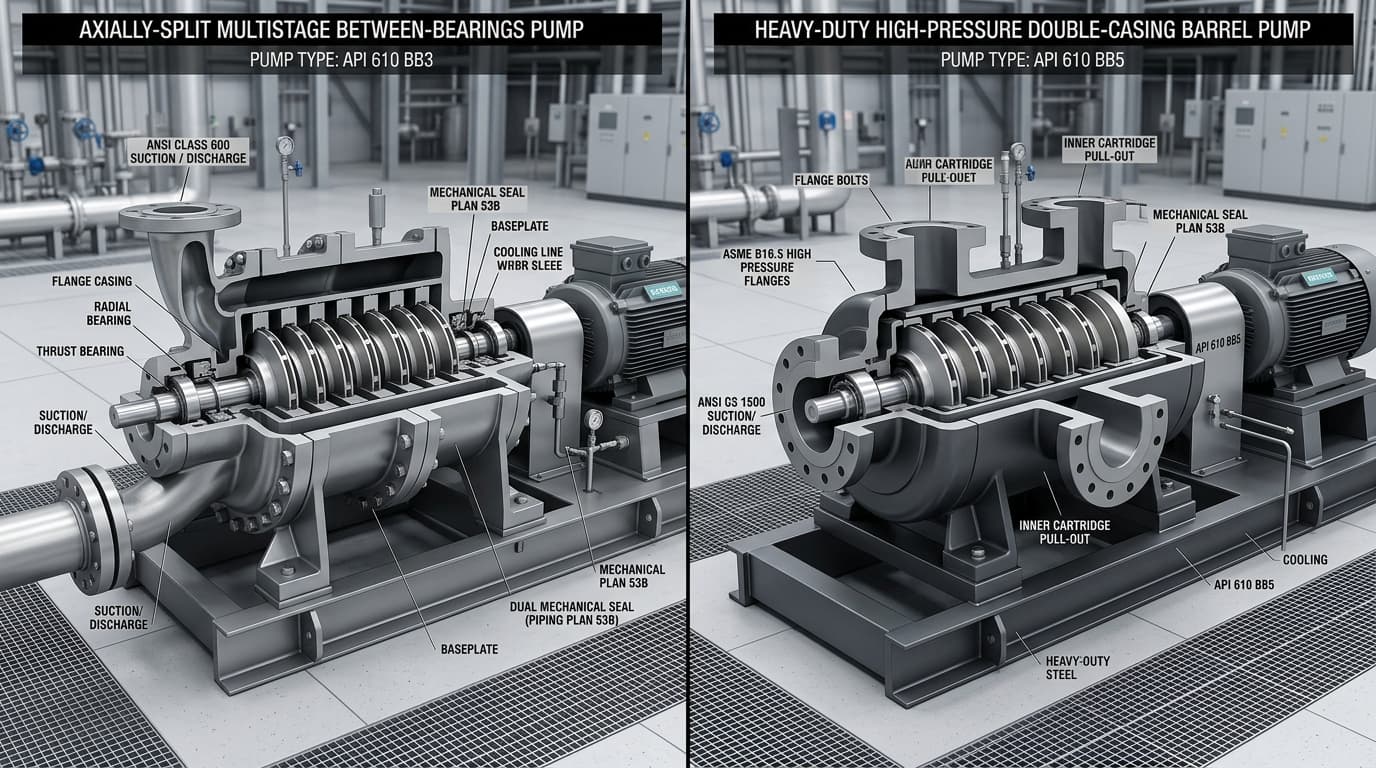
- BB3 (25–120 bar): Axially split multistage between-bearings. Opposed impellers eliminate axial thrust; allows top casing removal without disturbing piping.
- BB5 (>120 bar): Double-casing forged steel barrel with pull-out inner cartridge. Maximum thermal shock and extreme pressure containment.
- API 682 Plan 23: Mandated seal flush system featuring an internal pumping ring and external heat exchanger to protect mechanical seal faces.
Obtain Instant API 610 Casing & Stage Recommendations
Enter your boiler steam pressure and flow rate to generate automated machine classification and stage estimates.
Handbook Engineering Contents
- The Critical Role of Pump Architecture in Boiler Reliability
- Detailed Casing Breakdown: OH2 vs. BB3 vs. BB5 Architectures
- Comparative Engineering Matrix: Pressures, Temperatures & Thermal Cycling
- Mechanical Seal Flush Systems: API 682 Plan 23 vs Plan 11 & 53B
- Material Class Specifications per API 610 Annex H (S-5, S-6, C-6, A-8)
- Worked Industrial Plant Selection Scenarios
- Frequently Asked Questions (FAQ)
1. The Critical Role of Pump Architecture in Boiler Reliability
Boiler feedwater service combines extreme hydraulic heads (often exceeding 2,500 meters or 8,200 feet), high fluid temperatures (105°C to 180°C), and continuous thermodynamic service factors. The American Petroleum Institute (API) Standard 610 (equivalent to ISO 13709) establishes the global standard for heavy-duty centrifugal machinery reliability.
Selecting the improper casing configuration results in severe mechanical seal failures, shaft deflection, thermal distortion of gasketed parting flanges, or catastrophic pressure containment rupture during sudden cold-start thermal shocks.
2. Detailed Casing Breakdown: OH2 vs. BB3 vs. BB5 Architectures
API 610 OH2: Overhung Single-Stage Centerline-Mounted
P < 20 bar (300 psig)Mechanical Design: The impeller is cantilevered on the end of a shaft supported by bearings in a separate bearing housing. Centerline casing support allows radial thermal expansion without disturbing shaft alignment with the electric motor driver.
Advantages & Limitations: Lowest initial capital investment and smallest footprint. However, cantilever deflection limits maximum head to a single stage, restricting its use to small firetube boilers and auxiliary steam generators.
API 610 BB3: Axially Split Multistage Between-Bearings
25 bar ≤ P ≤ 120 bar (1,740 psig)Mechanical Design: Impellers are supported between two external hydrodynamic bearing assemblies, eliminating cantilever deflection. The heavy casing splits horizontally along the shaft centerline.
Opposed Impeller Hydraulic Balancing: Impellers are arranged in opposing back-to-back groups. Axial thrust created by the first group of stages directly cancels the thrust generated by the second group, reducing thrust bearing loads by 80% to 90%.
Maintenance Advantage: Plant mechanics can lift the upper casing half to inspect rotors, balance rings, and diffusers without disconnecting suction and discharge piping flanges.
API 610 BB5: Double-Casing Radially Split Barrel Multistage
P > 120 bar up to 350+ bar (5,000 psig)Mechanical Design: A complete inner hydraulic pump bundle (impellers, diffusers, shaft, and bearings) is inserted into a heavy forged steel cylindrical outer barrel. The barrel end is sealed by a heavy bolted radial cover flange with elastomeric or metal C-rings.
Thermal Transient Resilience: Because the cylindrical outer barrel has uniform radial wall thickness and circular symmetry, it expands uniformly during rapid startup thermal shocks. Unlike BB3 horizontal joints, the BB5 has no split gasket line subject to thermal bowing or steam wire-drawing.
Pull-Out Cartridge Feature: The entire inner hydraulic core can be extracted as a cartridge assembly for overhaul without unbolting the heavy forged barrel from the piping foundation.
3. Comparative Engineering Matrix: Pressures, Temperatures & Thermal Cycling
| Design Parameter | API 610 OH2 | API 610 BB3 | API 610 BB5 |
|---|---|---|---|
| Maximum Working Pressure | 20 bar (300 psig) | 120 bar (1,740 psig) | 350+ bar (5,075 psig) |
| Maximum Fluid Temperature | 140 °C (284 °F) | 160 °C (320 °F) | 260+ °C (500 °F) |
| Casing Split Geometry | Radial end-cover | Axial (horizontal parting plane) | Radial forged barrel with inner cartridge |
| Axial Thrust Compensation | Balance holes in impeller | Opposed back-to-back impellers | Balance drum / disc + thrust bearing |
| Thermal Shock Sensitivity | Low | Moderate (Joint bowing risk) | Extremely High Resistance |
4. Mechanical Seal Flush Systems: API 682 Plan 23 vs Plan 11 & 53B
Boiler feedwater is inherently poor lubricating fluid due to low viscosity at high temperature. Mechanical seal faces require specialized flushing to prevent face vaporization and dry running:
Plan 23 uses an internal pumping ring (scroll) integral to the seal cartridge to circulate water from the seal chamber through an external high-pressure water-cooled heat exchanger (cooler) and back onto the seal faces. Unlike Plan 11, Plan 23 isolates and recycles a small volume of water, cooling it down to 60°C–70°C. This delivers maximum seal life while conserving thousands of kilowatt-hours of plant thermal energy.
Plan 11 injects uncooled water directly from the pump discharge through an orifice into the seal chamber. Suitable only for low-temperature applications (<80°C). In boiler feed service, Plan 11 causes instantaneous flashing across seal faces.
Specified for toxic or zero-leakage environmental zones. Uses a bladder accumulator to maintain barrier fluid pressure higher than pump stuffing box pressure, guaranteeing zero steam or feedwater leakage to atmosphere.
5. Material Class Specifications per API 610 Annex H (S-5, S-6, C-6, A-8)
Feedwater velocity and purity dictate the metallurgical selection to prevent Flow-Accelerated Corrosion (FAC):
- Class S-5 / S-6 (Carbon Steel Casing + 12% Chrome Internals): Standard industrial boiler feed specification. Impellers, shaft, and wear rings are cast 12% Cr stainless steel (CA6NM / 410 SS) to prevent erosive wear at diffuser tips.
- Class C-6 (12% Chrome Steel Casing & Internals): Mandatory for demineralized water with low dissolved oxygen (<5 ppb) and pH < 9.0 where carbon steel casings suffer rapid Flow-Accelerated Corrosion wall thinning.
- Class A-8 (Austenitic 316L Stainless Steel): Specified for ultra-pure pharmaceutical clean steam generators and high-salinity marine desalination boiler loops.
6. Worked Industrial Plant Selection Scenarios
Three Practical Engineering Cases:
Selection: API 610 OH2 (Single-Stage Overhung) with API Plan 23 seal flush. Capital-efficient, small footprint, 2-pole motor @ 2950 RPM.
Selection: API 610 BB3 (Axially Split 6-Stage Opposed Impeller). Material Class S-6. Natural axial thrust balance, rapid casing access for turnaround overhauls.
Selection: API 610 BB5 (Double-Casing Barrel with Pull-Out Cartridge). Material Class C-6. Maximum resilience against rapid daily startup thermal cycling.
7. Frequently Asked Questions (FAQ)
When should an engineer specify an API 610 BB3 pump versus a BB5 barrel pump?
API 610 BB3 (axially split multistage between-bearings) pumps are ideal for pressures between 25 and 120 bar where rapid maintenance access is prioritized. When discharge pressures exceed 120 bar or the facility experiences severe thermal transient shocks (such as cyclic combined-cycle peaking plants), an API 610 BB5 (double-casing barrel) pump is mandatory because its cylindrical radial-split design eliminates long horizontal gasketed parting joints susceptible to thermal bowing leaks.
Why are opposed impellers used in API 610 BB3 multistage pumps?
Staging impellers in opposing back-to-back groups hydraulically cancels net axial thrust. Half the stages push fluid left-to-right, while the remaining stages push fluid right-to-left. This natural balancing eliminates the need for large balance drums and drastically reduces hydrodynamic thrust bearing loads during startup.
What mechanical seal flush plan is mandated for boiler feed water service per API 682?
API Plan 23 is the industry standard for high-temperature boiler feedwater. Plan 23 uses an internal pumping ring to circulate seal chamber fluid through an external water-cooled heat exchanger and back into the seal faces. Unlike Plan 11, Plan 23 only cools the recirculating seal chamber fluid rather than constantly cooling fresh high-temperature injection fluid, saving massive thermodynamic thermal energy.
What API 610 material classes are standard for boiler feed water pumps?
Standard practice mandates API Material Class S-6 (Carbon steel casing with 12% chrome stainless steel impellers, shafts, and wear rings) for general boiler feed service. For demineralized or ultra-pure feedwater where flow-accelerated corrosion (FAC) risk is high, Class C-6 (12% chrome steel casing and internals) or Class A-8 (316L austenitic stainless steel) is specified.
Can an overhung pump (API 610 OH2) be used for boiler feed service?
Yes, but strictly for low-pressure packaged firetube boilers operating below 20 bar (300 psig) and capacities under 80 m³/h. Centerline mounting prevents thermal shaft misalignment, but cantilever impeller overhang limits maximum head and stage count.
Ready to Size Your Machine?
Input your boiler steam rate and operating pressure to receive instant API 610 casing recommendations.